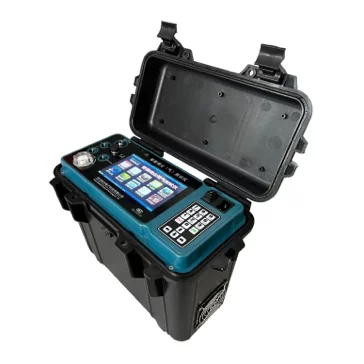

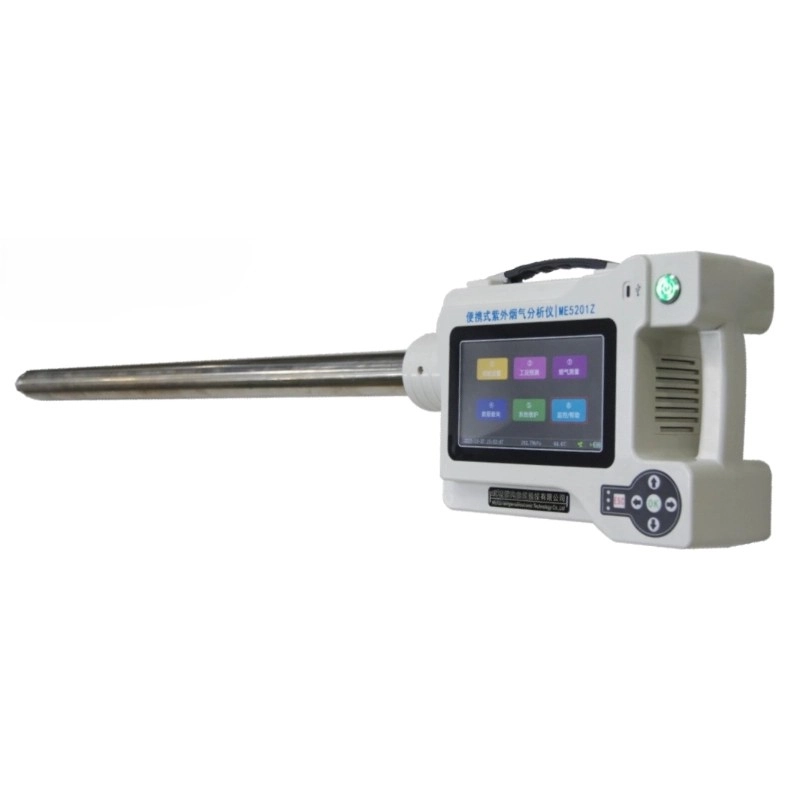
This analyzer adopts Ultraviolet Differential Optical Absorption Spectroscopy (UV-DOAS, hot-wet extraction method) to measure the concentrations of gases such as SO₂, NO, NO₂, NH₃, and H₂S in stationary source emissions. Its standout feature is high measurement accuracy without cross-interference from moisture (water vapor), making it the preferred choice for high-humidity, low-sulfur conditions with zero component loss.
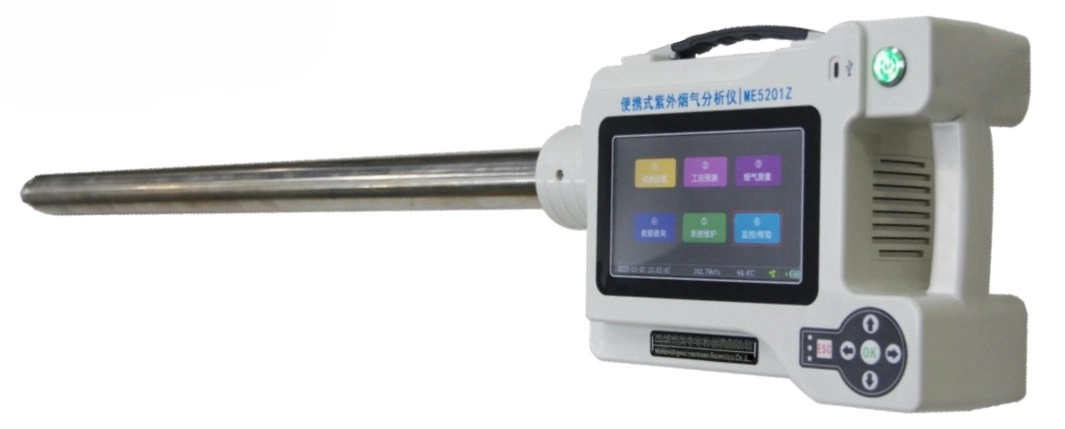
ME5201Z Portable UV Flue Gas Analyzer Features
- Adopts UV Differential Optical Absorption Spectroscopy (UV-DOAS, hot-wet extraction method) to measure gas concentrations of SO₂, NO, NO₂, NH₃, etc., in stationary source emissions; features high measurement accuracy without interference from water vapor, making it the preferred choice for high-humidity, low-sulfur conditions with zero component loss.
- Equipped with key core components such as a long-life, fast-warmup pulsed xenon lamp, and a spectrometer with ultimate precision and ultra-low detection limits.
- Internal optical components are protected by constant temperature control, high-temperature sealing, and shock absorption damping measures to effectively eliminate temperature drift and enhance data accuracy and stability.
- Dual-range design automatically switches between high and low ranges based on real-time emission concentration levels.
- All-in-one integrated design combining sampling, pretreatment, and main analysis unit; simultaneously measures flue gas temperature, flow velocity, and humidity with real-time dry-basis conversion; enables rapid on-site portable deployment; expandable to monitor CO₂, NH₃, H₂S, etc.; extensible sampling probes are available for ultra-high temperature environments.
- Full-path constant temperature heating for the sampling tube and gas chamber, titanium alloy vacuum insulation, anti-condensation, anti-corrosion, and easy to clean.
- Built-in condensate water removal, automatic drainage, and automatic gas cell purging to handle high humidity and protect sensors.
- 7-inch high-brightness color screen with dual touch/keypad operation, graphical Chinese interface, intuitive UI, and easy operation.
- Comprehensive EMC and electrostatic discharge (ESD) protection design, effectively resisting on-site static and electromagnetic interference.
- Equipped with high-capacity storage for real-time recording of minute, average, spectral, and total average data, complete with event logging; supports data export and system firmware upgrades via USB-C port.
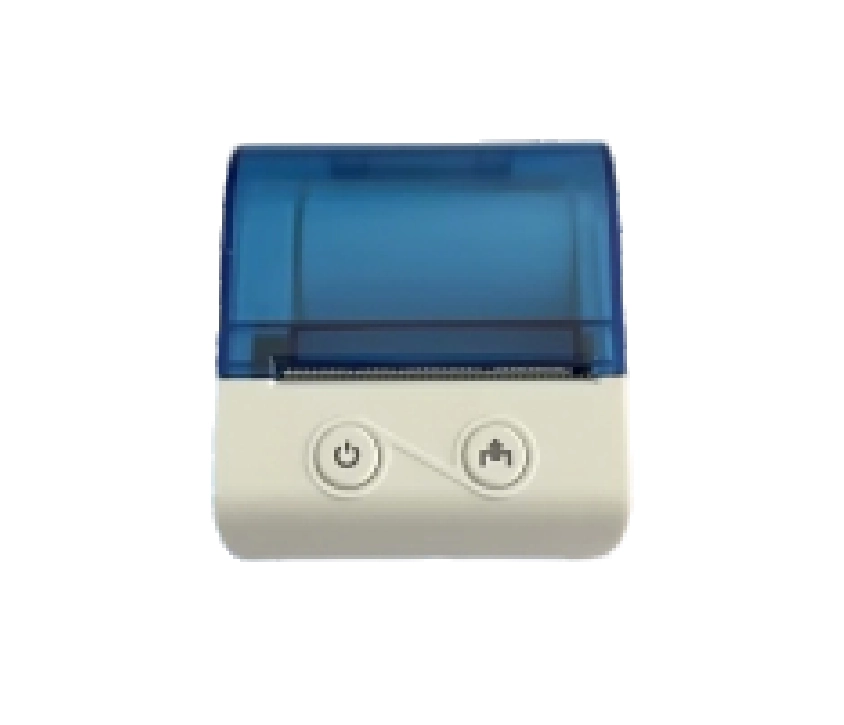
- Real-time test data query, standard wireless Bluetooth printer for immediate on-site printing, supports emissions load and concentration conversions.
- Built-in lithium battery supports continuous sampling, with an expandable external battery interface; supports automatic backflushing and purging after sampling.
- Optional handheld controller for remote operation, adaptable to harsh sampling environments.
- Prioritizes the BeiDou navigation system with optional multi-constellation GNSS compatibility, achieving automatic positioning and precise time synchronization (can also be configured to BeiDou-only positioning mode).
Configuration
Portable UV Flue Gas Analyzer Working Principle
The core technology behind this portable UV flue gas analyzer is Ultraviolet Differential Optical Absorption Spectroscopy (UV-DOAS). Based on the classic Beer-Lambert Law, it calculates gas concentrations by measuring how much UV light is absorbed by gas molecules.
Measurement Process Breakdown: After extracting the flue gas, the instrument performs four key steps internally:
- Light Source Emission: The internal UV light source (usually a pulsed xenon or deuterium lamp) emits a continuous beam of broad-spectrum UV light (wavelengths between 190nm – 400nm). This light is collimated and shot into the absorption cell (gas chamber) filled with the extracted flue gas.
- Gas Absorption (Molecular “Fingerprints”): As the UV light passes through the chamber, specific molecules (like SO₂, NO, NO₂) absorb light energy at specific UV wavelengths. Because different gas molecules have unique electronic energy levels, the “absorption peaks” they leave on the spectrum are completely unique.
- Grating Dispersion and Detection: The light is then guided into a spectrometer via optical fibers. A diffraction grating disperses the composite light into different wavelengths (like a prism) onto an array detector (such as a CCD or PDA), generating a complete spectral curve.
- Differential Algorithm (Filtering Interference): This is the essence of DOAS. The total absorption spectrum has two parts:
- Slow-varying part: Broadband absorption caused by dust scattering, water droplets, and light source attenuation.
- Fast-varying part: Intense, narrow absorption peaks produced by target gases (like SO₂). The built-in microprocessor uses a mathematical high-pass filtering algorithm to strip away the “slow-varying” background interference. It extracts only the “fast-varying” differential absorption spectrum, compares it against standard gas cross-section data, and calculates the exact pollutant concentration.
Beam Reflection Principle of the Reflective Gas Cell
Structure and Working Mechanism
Mirrors at Both Ends: High-reflectivity concave mirrors (typically coated with high-reflectivity films optimized for specific wavelengths) are installed at both ends of the gas cell.
Beam Folding: After entering the gas cell from the inlet, the ultraviolet light beam does not pass straight through; instead, it is directed at a specific angle toward the mirror at the opposite end.
Multiple Reflections: The beam undergoes systematic reflections—ranging from dozens to even hundreds of times—between the mirrors at both ends. With each reflection, the beam traverses the smoke-filled chamber once more.
Focused Exit: After the predetermined number of reflections, the beam exits the cell and enters the spectrometer for spectral analysis.
Industry Applications
Due to its portability and anti-interference capabilities, the instrument is widely used by regulatory agencies and heavy industries that require strict control over air pollutant emissions:
- Ecological and Environmental Monitoring: Environmental protection bureaus at all levels, environmental monitoring stations, and third-party CMA testing agencies.
- Power Industry: Coal-fired, gas-fired, and biomass power plants.
- Heavy Manufacturing: Iron and steel metallurgy (sintering machines, blast furnaces), cement and building materials, glass and ceramic manufacturing kilns.
- Petrochemical Industry: Oil refineries, fertilizer plants, coking plants, and natural gas extraction and processing.
- Solid Waste Treatment: Waste incineration power plants, hazardous waste treatment centers.
Typical Application Scenarios
1. Comparison and Calibration of CEMS (Continuous Emission Monitoring Systems)
Environmental regulations require companies to regularly calibrate their fixed CEMS. Due to its high precision, this portable UV analyzer is frequently used as a benchmark instrument. Inspectors bring it on-site and insert the sampling probe into the same flue cross-section as the fixed CEMS for synchronous sampling. This checks whether the fixed equipment has drifted or malfunctioned.
2. Efficiency Evaluation of Desulfurization and Denitrification (FGD / SCR / SNCR)
During environmental upgrades in power or steel plants, engineers must monitor gas concentrations at the inlet and outlet of desulfurization towers or denitrification reactors. The analyzer can perform spot checks at both the “raw gas” (untreated) and “clean gas” (treated) exhaust points to calculate the SO₂ or NOx removal rate. This helps optimize ammonia injection or limestone slurry levels, preventing excessive “ammonia slip” and lowering operational costs.
3. Emergency Detection for Unexpected Environmental Incidents
During industrial gas leaks, chemical plant explosions, or abnormal emission complaints, environmental enforcement officers can rush to the scene with this instrument. Requiring no complex preheating or pipe laying, it quickly measures specific pollutant concentrations at the emission source or plant boundary, providing critical data for emergency decision-making.
4. Combustion Optimization for Boilers and Burners
When thermal engineers commission new Low-NOx Burners or industrial boilers, they monitor NOx concentrations and oxygen levels in the exhaust in real-time to find the optimal Air-Fuel Ratio. This minimizes nitrogen oxide generation while maintaining high thermal efficiency.
5. Acceptance of Ultra-Low Emission Retrofits
With the enforcement of “ultra-low emission” standards (e.g., SO₂ < 35 mg/m³, NOx < 50 mg/m³), traditional electrochemical sensors experience massive errors at such low concentrations. The UV flue gas analyzer boasts an extremely low detection limit, making it the core measurement tool for the environmental acceptance of ultra-low emission engineering projects.
Reference Standards
Executive Standards
- HJ 1132-2020: Stationary source emission – Determination of nitrogen oxides – Portable ultraviolet absorption method
- HJ 1131-2020: Stationary source emission – Determination of sulfur dioxide – Portable ultraviolet absorption method
- HJ 1045-2019: Technical specifications and test procedures for portable flue gas (SO₂ and NOx) analyzers based on ultraviolet absorption method from stationary sources
- HJ 76-2017: Specifications and test procedures for continuous emission monitoring system of flue gas (SO₂, NOx, particulate matter) emitted from stationary sources
- HJ/T 397-2007: Technical specifications for emission monitoring of stationary sources
- JJG 968-2002: Verification Regulation of Flue Gas Analyzers
- GB/T 37186-2018: Gas analysis – Determination of sulfur dioxide and nitrogen oxides – Ultraviolet differential optical absorption spectrometry
- GB 13223-2011: Emission standard of air pollutants for thermal power plants